Artificial Intelligence in Water Safety Planning: A Path to Sustainability
Published on Aug 4, 2026
By Fatemah Dashti (Kuwait), Co-Chair of the Water Safety Planning Specialist Group at the International Water Association (IWA), and Angelo Siragusa (Italy), Team Leader of the Water Safety Planning Specialist Group at IWA
What is a Water Safety Plan
In 2004, the World Health Organization (WHO) and the International Water Association (IWA) introduced the Water Safety Plan (WSP) as a practical way to protect drinking water. A WSP takes a comprehensive approach to managing drinking water by assessing risks throughout the entire water supply chain, from the source to the tap (1,2). Rather than solely relying on endpoint water quality testing, the approach of WSP helps utilities to proactively ensure public health while improving the reliability and resilience of water systems.
Why is Artificial Intelligence now part of water planning
In recent years, artificial intelligence (AI) has emerged as a powerful tool in urban water management. Water utilities now generate large volumes of data from sensors, meters, modelling and laboratories. With the help of AI technologies, these large datasets can be analysed to manage uncertainties, make sense of the information, and turn them into useful insights (3). AI represents one of the most significant opportunities for advancing WSPs. As water systems face increasing challenges from climate change, population growth, aging infrastructure, and emerging contaminants, traditional approaches alone may not be sufficient to manage risks effectively.
By integrating Internet of Things (IoT) sensors, real-time monitoring systems, and machine learning algorithms, AI has the potential to transform WSPs from predominantly reactive frameworks into more dynamic, predictive, and adaptive risk-management systems. Rather than relying solely on periodic assessments and conventional water quality testing, AI can continuously analyse large volumes of operational and environmental data to identify emerging hazards before they affect consumers. Beyond improving water safety, these innovations can reduce operational costs and support more sustainable management of drinking water resources. For these reasons, AI should be viewed not merely as a technological innovation but as a strategic opportunity to enhance WSP's effectiveness and future relevance.
How can AI improve Water Safety Planning
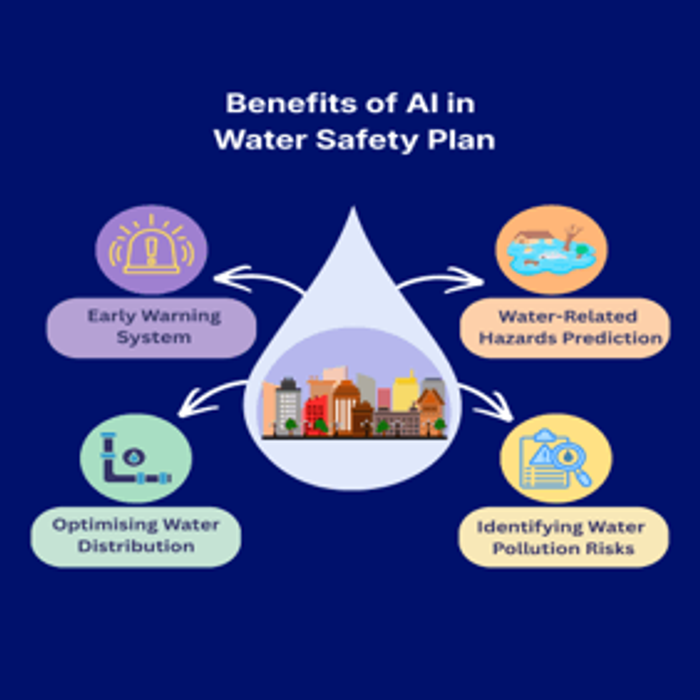
Integrating AI into WSPs can make water management safer and more sustainable. AI models can forecast floods, detect pollution risks, and support fairer water distribution. For example, machine-learning tools can identify patterns in water quality data and warn of possible contamination. This allows authorities to respond quickly and reduce risks to public health. AI also supports efficient resource management. Improved predictions enable utilities to optimize their operations, reduce water loss, and prepare for climate-related stress, such as droughts or heavy rainfall. For example, AI can also be applied in drinking water treatment by combining weather and rainfall forecasts with historical data to predict raw water availability and water demand. These predictions help operators anticipate changes such as higher turbidity after heavy rain or increased demand during dry, hot periods. As a result, treatment processes like intake control, filtration, and chemical dosing can be adjusted in advance. This improves operational efficiency, maintains water quality, and ensures a more reliable water supply. Transparency is also considered very important. When AI models are designed to be transparent and easy to understand, water managers and policymakers can better understand how decisions are made. This supports good governance and safer outcomes, building trust in data-driven decision-making (4).
Real-world examples of AI supporting Water Safety Plans
Practical applications of AI implementations significantly strengthen WSPs by improving monitoring accuracy, infrastructure integrity, and predictive capabilities. Advanced spatiotemporal deep learning models, such as Graph Transformers, are successfully utilized in water distribution networks to detect and localize concurrent leaks, which reduces the risk of contaminant intrusion and ensures network reliability (5).
In large-scale river basin management, Artificial Neural Networks (ANNs) integrated with the Criterion Impact Loss (CILOS) weighting method have been applied to the Mahanadi River in India to pinpoint pollution hotspots influenced by agricultural runoff and municipal waste (6). These AI-driven assessments allow authorities to categorize water safety on a scale from "excellent" to "extremely poor," facilitating targeted remediation to protect public health. Other research shows that data-driven classifiers such as XGBoost, LightGBM, and CatBoost automate water safety prediction with accuracy exceeding 96%. These models are effective at identifying hazardous concentrations of substances such as arsenic, lead, and bacteria (7). AI is also being integrated with IoT monitoring systems. Sensors can transmit real-time water quality data, while computer vision technologies, including drones used for dam inspections, support infrastructure monitoring. Decision-support systems built on these technologies can provide early warnings when water quality indicators exceed safe thresholds, enabling faster responses (8). These examples demonstrate how AI is transitioning into a practical tool for WSPs.
What are the risks of using AI in WSPs
Despite its benefits, AI also introduces new challenges that must be carefully managed. As AI systems are highly dependent on the quality, completeness, and representativeness of the data used for training and operation. Poor data can lead to misguided decisions. Forecasting errors, system failures, and poorly designed models may introduce new risks rather than reducing them. In water safety applications, sensor data may be incomplete due to infrastructure gaps or biased toward urbanized or well-monitored areas. AI models are often uncertain because they rely on probabilistic learning from historical data. One key challenge is that these models may overfit to past conditions. Calibration issues may introduce noise into the dataset. In addition, errors can arise when models are applied to extreme or rare events that are underrepresented in training data. AI systems can require significant energy, raising environmental concerns. At the same time, digital water infrastructure may become vulnerable to cyber threats. Limited transparency makes some decisions difficult to understand or challenge. Without proper governance, these issues can undermine trust in AI-based water management (9). To manage these risks responsibly, AI should be integrated within structured tools such as Failure Mode and Effects Analysis (FMEA). This enables utilities to systematically evaluate the severity, likelihood of occurrence, and detectability of potential failures.
What needs to be done
For AI to support WSP effectively, strong foundations must be in place. Water utilities need good data management, clear documentation, and transparent modelling approaches. AI tools should be designed to be interpretable and subject to review so that decisions can be understood, questioned, and improved. Clear institutional roles and regulatory frameworks are also needed to guide the responsible use of AI in water management. With these safeguards in place, AI becomes a reliable tool for water utilities. It directly protects drinking water quality, improves system management, and keeps water safe for the public.
References:
Yehia, A. G., Mehany, M. A., Fareed, A. M., El‐sayed, W. H., & Taman, M. S. (2024). The role of water safety plan (WSP) to enhance the compatibility in water sector, Egypt. World Water Policy, 10(2), 524-552.
WHO. (2004). Guidelines for drinking water quality ( 3rd ed.). World Health Organization. http://www.who.int/water_sanitation_health/publications/gdwq3/en/
Xiang, X., Li, Q., Khan, S., & Khalaf, O. I. (2021). Urban water resource management for sustainable environment planning using artificial intelligence techniques. Environmental impact assessment review, 86, 106515.
Anwar, M. R., & Sakti, L. D. (2024). Integrating artificial intelligence and environmental science for sustainable urban planning. IAIC Transactions on Sustainable Digital Innovation (ITSDI), 5(2), 179-191.
Wang, H. (2026). AI for detecting and localizing concurrent abrupt and incipient leaks in water distribution networks. Water Research, 125538.
Das, A. (2025). Water pollution and water quality assessment and application of criterion impact loss (CILOS), geographical information system (GIS), artificial neural network (ANN) and decision-learning technique in river water quality management: An experiment on the Mahanadi catchment, Odisha, India. Desalination and Water Treatment, 321, 100969.
Karthick, K., Krishnan, S., & Manikandan, R. (2024). Water quality prediction: a data-driven approach exploiting advanced machine learning algorithms with data augmentation. Journal of Water and Climate Change, 15(2), 431-452.
Morain, A., et al. (2025). Artificial intelligence applications in water management: bibliometric analysis, challenges, and knowledge gaps. Journal of Water and Climate Change, 16(12), 3610-3647.
Infant, S. S., Vickram, S., Saravanan, A., Muthu, C. M., & Yuarajan, D. (2025). Explainable artificial intelligence for sustainable urban water systems engineering. Results in Engineering, 25, 104349.
Find out more info on the (WSP) Portal: Link here.