Building a Resilient Water Future for Phnom Penh, Cambodia
Published on Dec 18, 2025
By Mrs. KHEN Chanlyda, Engineer of the Department of Research and Development, Mr. SAMAUN Sereysomanuh, Director of the Department in charge of Research & Development and H.E LONG Naro, Director General of Phnom Penh Water Supply Authority.
Problem
Water utilities around the world are facing a significant challenge: ensuring reliable, high-quality water access in a future shaped by climate change. This necessitates a transformation from simply delivering water to becoming a proactive leader in climate resilience and sustainability. Responsible for producing clean water and supplying drinking water to the urban city of Phnom Penh, PPWSA is challenged by several factors affecting service delivery. Issues around urbanisation, infrastructural expansion, and PPWSA's ageing water system have all contributed to an increase in Non-Revenue Water (NRW), compromising the utility’s financial viability.
Climate change further exacerbates these challenges, with erratic rainfall patterns and extreme weather events threatening water sources and overall system resilience. To mitigate these challenges, PPWSA has put in place adaptive measures to ensure the sustainability of the utility.
Solution
Adapting to climate change
To address the anticipated impacts of climate change on service delivery, PPWSA has implemented a comprehensive strategy that integrates infrastructure resilience, technological advancements, Non-Revenue Water and resource efficiency.
Currently, PPWSA has improved its civil engineering design to enhance ventilation for electromechanical equipment to withstand higher temperatures. Also, they have redesigned their intake pumping stations to account for drought risks, enabling water abstraction from the Mekong River even at critically low levels.
Over the last 30 years, the Phnom Penh Water Supply Authority has also prioritised the issue of Non-Revenue Water (NRW). Several efforts invested in this resulted in significant progress in reducing NRW, lowering it from 72% in 1993 to 8.93% in 2023. Although this achievement was regarded as an incredible success, sustainability was considered a challenge as the supply system ages and leakage becomes more difficult to control. However, PPWSA is dedicated to reducing NRW as lower as possible by 2030 by replacing ageing pipes and modernising water infrastructure with a leak detection system.
Again, through technological innovations, such as the installation of variable frequency drive (VFD) systems across all water treatment plants, PPWSA has improved pump performance, reduced breakdowns, and extended equipment lifespan. Complementing this, the adoption of smart monitoring systems like Supervisory Control and Data Acquisition (SCADA) supports efficient operations, conserves water, minimises energy use, and reduces greenhouse gas (GHG) emissions. PPWSA also has a SUMS system for billing management to read and record water consumption of customers for billing collection and revenues. Currently, PPWSA is working on a digital transformation system platform for a better smart water network management system with Japan and Korean Cooperation for more efficient operation and maintenance of our water network management and production infrastructure.
Additionally, PPWSA’s block tariff structure in its pricing strategy encourages customers to conserve water and adopt sustainable habits, ensuring the utility’s efforts are aligned with both operational sustainability and climate resilience.
Mitigation actions
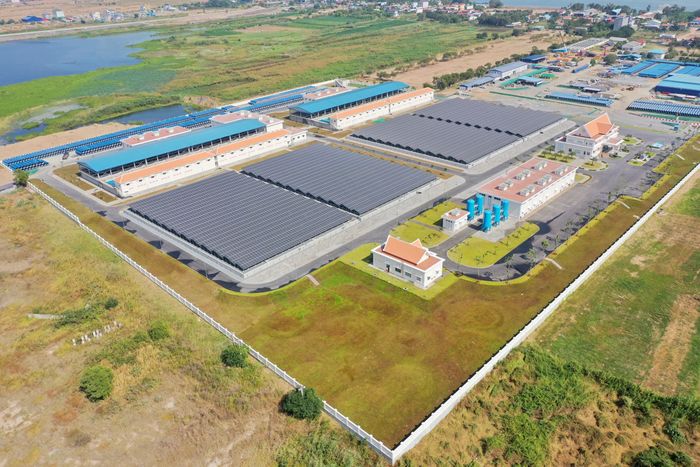
PPWSA is actively advancing a low-carbon trajectory through innovative initiatives and sustainable practices. The installation of solar panels at water treatment facilities has significantly reduced CO₂ emissions, with reductions of 974 tons in 2014 and 1,115 tons in 2016 at Phum Prek alone. This solar system has been extended to the Bakhaeng Water Supply Project, where 7,000 panels generate 3.8 megawatts of power, cutting the facility’s reliance on the national grid by 30%. These efforts reflect PPWSA’s commitment to energy conservation and sustainable development.
In addition, PPWSA also has a strategy in place for resource recovery within its water treatment processes, including reusing water from the backwash cycle for non-potable applications like industrial use or irrigation, thereby reducing freshwater demand. A rainwater harvesting system is also under consideration to conserve water, manage stormwater runoff, and mitigate urban flood risks. These multifaceted approaches enhance efficiency, promote sustainability, and minimise environmental impacts.
Leadership
Developing the skills of our workforce is essential to ensure that the next generation is well-prepared to sustain PPWSA’s operational excellence. By investing in comprehensive training programs, PPWSA aims to equip its staff with the knowledge and tools required to implement the best practices in water management. In line with this vision, PPWSA has an ambitious plan to conduct feasibility studies for establishing a dedicated training centre focused exclusively on the water supply sector in Cambodia.
Communication with citizens
PPWSA is committed to aligning with Cambodia's “Pentagonal Strategy-Phase I,” launched by the Royal Government of Cambodia, prioritising “People, Road, Water, Electricity, and Technology.” To achieve this, PPWSA has established a Department of Research and Development (R&D), encompassing three divisions: research & institutional development, technology & innovation, and a training centre. This department ensures adherence to the organisational “Action Plan” through the development of performance monitoring systems and enforcement of Standard Operating Procedures (SOPs), which are periodically reviewed. It is also tasked with updating the staff statute to align with SOPs and strategic goals. Central to this effort is the Training Centre, which plays a key role in developing a highly skilled workforce to address water supply challenges, offers comprehensive training, promotes best practices, and collaborates on public education initiatives to encourage community-wide water conservation.
These initiatives position PPWSA as a leader in environmental responsibility and human resource development, equipping the organisation to tackle climate change challenges while safeguarding essential services and advancing sustainable practices. Collectively, these efforts highlight PPWSA’s dedication to fostering innovation, promoting equitable solutions, and inspiring meaningful climate action.
Submit your Utility Case Story
Feeling inspired by this story? Learn more about the IWA Climate Smart Utilities Initiative or contact us at climate@iwahq.org