Reflections on the 2026 UN Economic and Social Council Partnership Forum
Published on Feb 18, 2026
By Joelle Solowiejczyk, IWA YWP member, Water Resilience Management Consultant
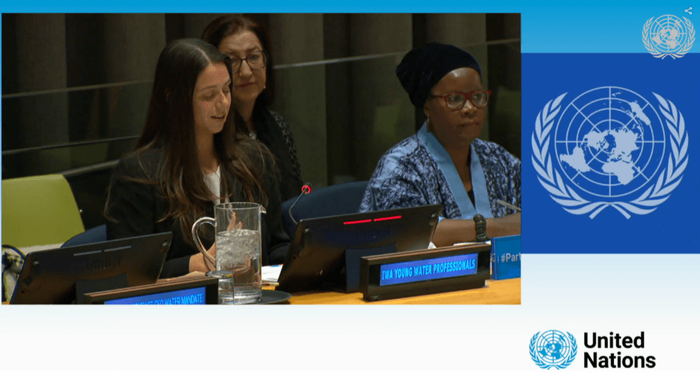
On January 27, 2026, I had the honour of speaking as a panelist at the UN Economic and Social Council (ECOSOC) Partnership Forum during the SDG 6 action session on behalf of the IWA Young Water Professionals community. The session focused on partnerships to advance global water security. Our panel covered partnerships to advance gender equity, intergenerational dialogue, private sector action, inclusion of holistic knowledge and participation of the UN system and other international organisations – quite a lot of ground to cover in a one-hour session. The room was full, the discussion was thoughtful, and the sense of urgency was clear.
Later in the day, I represented the panel in a broader forum discussion. As I concluded my second address, I reflected:
The forum was a six-hour event, recorded for posterity. But realistically, few will sit down to watch it in full. The real impact of my words and everyone else’s is contingent on what participants carry forward and who they influence.
So, the natural question is, what happens now?
In my panel contribution on intergenerational partnerships and the role of the young water professional (YWP), I framed the conversation within the new era of “water bankruptcy”. Globally, water utilities face climate-induced hydrological stress, and climate-agnostic water stress from ageing infrastructure, shifting geographic and sectoral demand patterns, and overextraction. How these “global” challenges are permuted and how they manifest locally is, of course, dynamic. But one challenge is ubiquitous: the processes, governance structures and goals of long-standing institutions are insufficient to meet the widening gap between water security ambition and water service delivery.
When we think about what fundamentally drives the pursuit of global water security, we often speak about the human right to water. I deeply agree with the moral imperative behind this, but for this right to exist as more than a normative ideal, it must be operationalised. The human right to water becomes tangible when utilities function sustainably, institutions are designed for adaptive change rather than stability over time, and affordability is considered through a more constructivist lens.
Partnerships – the focus of this SDG 6 Action Session – are a key delivery mechanism to reduce the widening ambition-delivery gap and to, in turn, operationalise the human right to water. At leadership and operational levels, institutions and organisations must consider whether we are collaborating where collective effort accelerates impact. Are we sharing knowledge and giving credence to all potential sources, instead of duplicating effort? Or are we still working fragmented and in parallel?
As a YWP, I find the prospect of strengthening collaborative planning and operational efforts to be both challenging and motivating – though these feelings can be closely connected. “Challenging” because institutional change is often slow. Progress, especially in the water sector, rarely happens in swift, newsworthy moments. It tends to unfold through incremental policy shifts, revised water use and management strategies, and infrastructure planning that is simultaneously long-term and adaptive. Individual and local changes could bring a positive difference in a matter of days, but for regional, transboundary and global changes, results may take years to become visible.
That same reality can be highly motivating. It means that the work we do today matters beyond this SDG cycle, and the systems we strengthen now will shape water security long after 2030.