The Global Sanitation Crisis in a Changing World
Published on Nov 18, 2025
by the IWA Inclusive Urban Sanitation Team
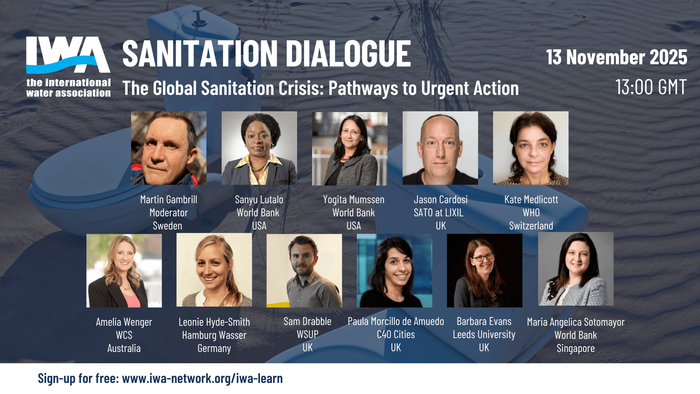
On November 13, representatives of the IWA Inclusive Urban Sanitation Initiative, the IWA Specialist Group on Sanitation and Water Management in Low- and Middle Income Countries and the World Bank took part in the online Sanitation Dialogue on the Global Sanitation Crisis. Based on the recently released World Bank report, "The Global Sanitation Crisis: Pathways to Urgent Action", this dialogue facilitated enriching discussions on the current challenges on sanitation and potential pathways to Climate-Resilient Sanitation (CRS).
Access to safe water and adequate sanitation is central to the mission of IWA. As highlighted by the 2025 World Toilet Day theme, "Sanitation in a changing world", there is a need for urgent action to address the global sanitation crisis. With the added pressures of climate change and economic challenges, the sanitation sector is working overtime to develop resilient, inclusive, and environmentally sound solutions.
Here were share the key takeaways from the dialogue, reflecting the important messages from the World Bank report.
Message 1: The Climate Crisis is a Sanitation Crisis—Ignoring It Affects Billions
The global sanitation crisis is alarmingly off-track for meeting Sustainable Development Goal 6 (SDG 6) to achieve universal, safely managed urban sanitation by 2030, requiring a fivefold acceleration in progress. Climate change is critically exacerbating this crisis.
- The Triple Burden: Up to one-third of urban populations in low- and middle-income countries (LMICs) are afflicted by a ‘triple burden’ of poverty, climate risk, and inadequate access to sanitation services. Approximately 1.1 billion urban residents are exposed to the combination of poverty, insufficient sanitation, and flooding.
- Climate Hazards Exacerbate Disease: Climate-induced hazards, such as floods, droughts, and rising sea levels, are stressing already inadequate sanitation systems and services. Flooding contaminates water supplies by causing wastewater systems to overflow, spreading pathogens linked to diseases like cholera, dysentery, and typhoid.
- The Cost of Inaction: Poor sanitation does more than threaten health; it blocks human development, stunts economic growth, and hurts the environment. The costs of inadequate sanitation are substantial, with losses exceeding 2% of GDP in South Asia and Sub-Saharan Africa. The costs of implementing CRS systems are expected to be far lower than the estimated costs of inaction.
Message 2: Resilience is the New Standard: Safely Managed Sanitation in a Hostile Climate
To protect public health and maintain stability, the world needs a fundamental shift from a vicious cycle (inadequate, vulnerable sanitation) to a virtuous cycle of climate-resilient, mitigation-positive sanitation services for all.
- Defining Climate-Resilient Sanitation (CRS): CRS means delivering “safely managed sanitation in a more hostile climate”. These services must anticipate, respond to, cope with, recover from, adapt to, or transform from climate-related disruptions, while maintaining universal access.
- Adopting CWIS: The Citywide Inclusive Sanitation (CWIS) approach is the robust foundation for achieving CRS, emphasizing universal access across the entire service chain (onsite and sewered solutions) and tackling structural inequities.
- Building Resistant Systems: Adaptation strategies involve elevating sanitation facilities to withstand floods, using low-water or no-water toilets in water-scarce areas, and implementing resilient designs such as corrosion-resistant materials and flood defences. Active management, such as regular, scheduled emptying of onsite systems (FSM) before rainy seasons, is crucial to prevent contamination and safeguard public health.
Message 3: Toilets as Resource Hubs: Embracing the Circular Economy
Sanitation systems can transform from sources of pollution and Greenhouse Gas (GHG) emissions into valuable resource recovery systems, contributing positively to planetary health and shared prosperity.
- GHG Mitigation Opportunity: If poorly managed, the sanitation sector is a significant source of GHG emissions, notably methane (CH4). Providing safely managed sanitation could reduce global methane emissions by up to 10%.
- Turning Waste into Wealth: Circular economy approaches treat wastewater and faecal sludge as resources for water, energy, and nutrients. Processing faecal sludge through anaerobic digestion produces and captures biogas, offering a renewable energy source and mitigating emissions.
- Protecting the Planet: By managing waste safely, the sanitation sector contributes to maintaining the delicate balance of Earth’s environmental systems and intersects with seven of the nine planetary boundaries. Regenerative actions, such as resource recovery and reuse, help protect ecosystems and prevent pollution of freshwater and marine environments.
Message 4: The Call to Action: Integrate, Finance, and Innovate
Accelerating CRS requires comprehensive policy shifts, integrated planning across urban sectors, and significant new financing.
- Integrated Planning is Essential: CRS planning cannot happen in isolation. Sanitation must be integrated with wider urban services, including water supply, drainage, stormwater management, solid waste, and transport, requiring cross-ministry and cross-sectoral collaboration.
- Policy and Finance must Align: Governments must adopt flexible planning and regulatory frameworks and integrate sanitation into national climate commitments, such as Nationally Determined Contributions (NDCs) and National Adaptation Plans (NAPs), to create "top-down" drivers for CRS programs.
- Closing the Financing Gap: While public sector leadership is critical due to sanitation's nature as a public good, financing requires a blend of public funding, tariffs, private investment, and leveraging climate and green funding mechanisms (like green municipal bonds and carbon credits).
Innovation and Data: To achieve adaptive, resilient, and sustainable systems, capacity building and the adoption of innovative technologies—including Artificial Intelligence (AI), digital twins, and advanced monitoring systems—are needed to promote evidence-based decision-making and optimise operations.
Feel free to watch the on-demand recording of the dialogue here: