Why Kenya’s Rural Response Matters for Water and Sanitation Regulation
Published on Sep 8, 2025
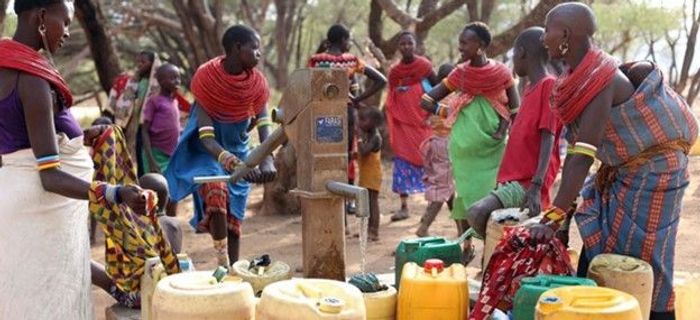
Photograph 1 of Samburu Women in Kenya Fetching Water, Source Los Angeles Times
By Euphresia Luseka
“With this report, we've tracked the efforts of countries to progress on water and sanitation. We know the situation is terrible; billions of people are without access to these basic services,” said Dr. Bruce Gordon, Head of Water, Sanitation and Hygiene, WHO. This stark assessment underscores the urgency behind the Call to Action on Strengthening Water and Sanitation Regulatory Systems, launched by the World Health Organization (WHO), the International Water Association (IWA) and more than 40 other partners in June 2025.
Grounded in objectives of embedding regulation in national policy, strengthening institutional capacity, ensuring inclusive participation and transparency, the Call to Action reframes regulation as a sovereign governance tool, turning political commitments on water and sanitation into enforceable, measurable, and lasting outcomes.
For Kenya, The Call to Action Resonates with Structural Urgency
Kenya’s Water Services Regulatory Board (WASREB) reports that, while the Water Act 2016 devolved water and sanitation delivery to county governments, enforcement remains fragmented. WASREB highlights that 41% of Kenyans live beyond formal Water Service Provider (WSP) coverage. At the same time, 2.8 million depend on unregulated small-scale operators.
The divide is sharpest between urban and rural areas. Rural areas, where community-managed schemes dominate, face persistent accountability gaps that leave residents ‘effectively discriminated against’ in their right to safe, sustainable water services. As of 2022, JMP and the Kenya National Bureau of Standards report that around 68% of Kenyans have access to basic drinking water services, with 91% in urban areas compared to 56% in rural areas. Climate change, population growth, and resource scarcity exacerbate this inequity.
Kenya’s reforms, anchored in the Water Acts (2002, 2016, 2024), Vision 2030, the National Water Master Plan, and devolved county strategies, therefore, represent more than legal milestones. They are a strategic test: can regulation deliver universal access, safeguard scarce resources, and build resilience within a generation? As one participant at the global launch of the Call to Action asserted during the launch: “The world cannot wait; let’s move from commitment to action.”
Persistent Rural Water Sustainability Challenges
“Despite Kenya’s strong legal framework, rural water services remain uneven and chronically under-resourced,” said the Samburu County Executive Committee Member for Water. According to REACH Water, nearly 44% of Kenyans without basic water services live in rural areas, where community-managed water schemes dominate. These systems are technically ‘born unfinished,’ lacking long-term support to remain functional.
Financial constraints are a recurring fault line. WASREB’s 2023/24 Impact Report confirms this: 31 out of 47 counties have WSPs recovering less than 100% of O&M costs. While the average tariffs of US$0.60/m³ barely cover operating costs, nearly 45% of water is lost as Non-Revenue Water (NRW) through leaks, illegal and un-metered connections.
Although Section 94(3) of the Water Act 2016 recognises Community WSPs and permits clustering of rural schemes, in practice, many remain run by under-resourced and unprofessional committees, vulnerable to weak governance and political interference. Volatile demand from farmers and pastoralists and the absence of a unified maintenance agency compound the challenges. Consequently, rural water services often break down, undercutting Article 43(1)(d) of the Constitution of Kenya 2010, which guarantees the right to clean, safe and adequate water.
Monitoring remains weak. WHO reports rural water services monitoring is minimal, with little systematic reporting to regulators or government. This regulatory gap undermines SDG6 and the Global Call to Action’s demand for regulation that prioritises underserved populations.
Regulation, Not Just Infrastructure, Is the Driver
Kenya’s water regulatory progress has been notable. WASREB has gained global respect for its statutory independence, institutionalising and enforcing: Performance Contracts, Service Delivery Management Models, Licensing informal providers, Sectoral and Citizen Scorecards. The Water Tribunal reinforces governance, echoing the Call to Action for autonomous, accountable oversight. Water Action Groups and public consultation align regulation with the needs of underserved populations.
Yet, financing remains the bottleneck. Kenya’s Water infrastructure needs exceed available resources by 46%. The state-owned WaterFund, a results-based financing program backed by SIDA and the World Bank, is responsible for blending loans and subsidies to incentivise rural WSPs. Non-governmental organisations, such as Water.org, are also advancing household-level financing. But domestic capital markets, green bonds, and climate funds remain underutilised.
Experts argue that scaling innovative mechanisms, such as ecosystem services payments, micro-insurance, and blended finance, could unlock sustainable investment flows and elevate rural water into an investment-grade sector.
From Commitments to Measurable Impact

Photo by Jeff Warewu
The Call to Action outlines four priorities that resonate with Kenya’s rural water challenge:
Political commitment: Water is enshrined as a constitutional right. Translating this into consistent county-level execution requires insulating regulatory decisions on licensing and tariffs from political cycles and budget fluctuations.
Sustainable financing: Results-based financing should be complemented by domestic bonds, climate finance, philanthropic ‘first-loss’ capital, and corporate partnerships to make rural water viable and attractive for investment.
Pro-poor targeting: Tariff structures and connection fees must not exclude the poorest. Smart subsidies combined with financing mechanisms can expand access while maintaining WSP solvency.
Monitoring and accountability: Tariff structures and connection fees must not exclude the poorest. Smart subsidies combined with financing mechanisms can expand access while maintaining WSP solvency.
Other African Countries offer adaptable models. Burkina Faso’s ONEA and Côte d’Ivoire’s SODECI show that insulated regulators, predictable tariffs, multi-year investment planning, and climate-informed strategies can expand rural services. As a member of the Eastern and Southern Africa Water and Sanitation Regulators Association (ESAWAS), Kenya has a platform to exchange and adapt such experiences.
As Dr Batsirai Majuru (WHO/IWA, 2025) emphasised: “We must improve the political space for regulators, address inequalities in service provision, and strengthen the capacity of regulatory institutions and associations.”
For Kenya, the issue is not whether regulation exists, since it does. The question is whether regulation can overcome structural barriers and function as a binding governance instrument at both national and county levels.
If so, the Call to Action can support Kenya in delivering on its constitutional promise, while setting a precedent across Africa: proving that regulation, when backed by vision, integrity, and fiscal discipline, can deliver both equity and resilience.
References
Constitution of Kenya. (2010). Constitution of Kenya, 2010. National Council for Law Reporting. https://www.klrc.go.ke/index.php/constitution-of-kenya
International Water Association (IWA). (2025). Global call to action on strengthening water and sanitation regulatory systems. https://iwa-network.org
Kenya Law. (2016). Water Act, No. 43 of 2016. National Council for Law Reporting. https://www.kenyalaw.org/lex/actview.xql?actid=No.43of2016
Kenya Water Sector Trust Fund [WaterFund]. (2025). Results-based financing programme. https://www.waterfund.go.ke/
REACH. (2025). Kenya’s rural water regulations: Bridging the gap. University of Oxford. https://reachwater.uk/wp-content/uploads/2025/01/Kenya-rural-water-regulations-Jan2025.pdf
Water Services Regulatory Board [WASREB]. (2024). Impact report 17: Performance review of Kenya’s water services sector 2022/23. WASREB. https://wasreb.go.ke
World Health Organization (WHO). (2025). Call to action on water and sanitation regulation. WHO. https://www.who.int