Women Don't Just Carry the Water — they can manage, address, and reconceive the water crisis effectively, and make a difference for water quality
Published on Mar 18, 2026
By Rakesh Kumar, Biosystems Engineering, Auburn University, Auburn, United States of America
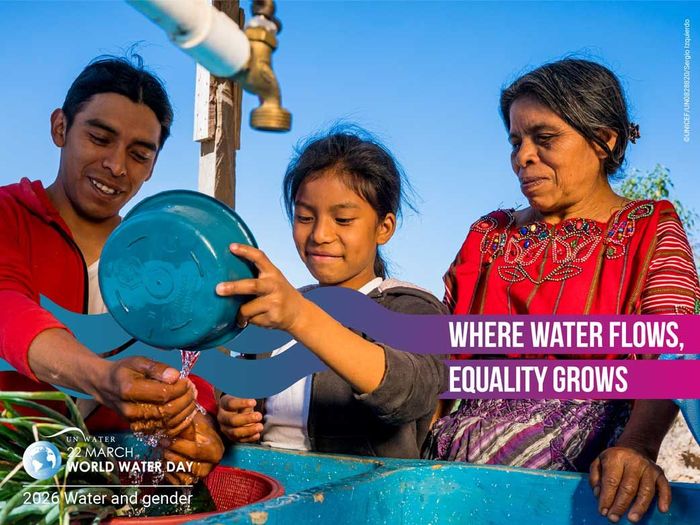
Think of a woman walking before sunrise in a place where water crises still exist. She carries a heavy jerry can on her head. She does this every day, sometimes for hours at a time. She is not the exception — she is the rule.
Around the world, women are the primary collectors, managers, and guardians of water in their homes and communities. Yet when decisions about water are made — the policies, the pipe networks, the budgets — women are largely absent from the table.
This World Water Day, the theme is Water and Gender. And it is one of the most important conversations we can have in the water sector right now, regarding both quality and quantity.
The water crisis is, in many ways, a women's crisis
Around two billion people still lack access to safe drinking water at home. Roughly half the global population lacks safely managed sanitation. These are staggering figures.
When water is scarce or unsafe, inequality deepens and it deepens fastest for women. They are the ones who walk the farthest to collect water. They are the ones who nurse sick family members, the ones who miss school because there are no separate, safe toilets. Women are the ones who face danger and indignity when they have to defecate in the open.
Time spent on water collection — globally, an estimated 200 million hours every day — is time not spent on education, income, or rest. This sits at the heart of why safe water and sanitation are recognised as fundamental human rights under international law.
Women manage water. So why don't they lead it?
Here is the paradox. Women are often the most knowledgeable and experienced ones when it comes to managing water at the household and community level. This is not just an equity argument, it is also about practicality. We are designing water systems without the expertise of the people who know them best. They know which sources are reliable in terms of water quality. They know the seasonal changes. They understand what their families need. Yet in water governance structures women remain dramatically under-represented.
A transformative approach means more than representation
A rights-based approach to water and gender means addressing the social norms that keep women out of technical roles, the financing gaps that leave women-led organisations without funding, and the governance structures that were never designed to include women's voices. It means women working as engineers, scientists, sanitation technicians, farmers, and community leaders, not as beneficiaries waiting for solutions designed by others. It means investing in girls' education in water and science. Thus, a transformative approach means that water utilities set gender targets that are actually monitored and reported. And it means international financing institutions asking hard questions about who their money reaches.
The Sustainable Development Goals (SDGs) are explicit about this. SDG 6 calls for universal access to safe water and sanitation, SDG 5 calls for gender equality. These goals reinforce each other, and one cannot be achieved without the other.
Men are part of this too!
Men have a vital role as allies: sharing the load of water collection at home, challenging the assumptions in their workplaces and communities that keep women out, means supporting daughters, sisters, and colleagues who are pursuing careers in the water sector, and speaking up when gender is treated as a box to tick rather than a genuine priority.
The moment calls for courage
We face a gathering storm of water-related pressures. Climate change is intensifying droughts and floods. Urban growth is straining ageing infrastructure. Financing gaps are widening. And social inequalities are making communities less resilient, not more.
Meeting these challenges requires everyone. The water sector cannot afford to operate at half-capacity by leaving women's talent, knowledge, and leadership on the sidelines.
On this World Water Day, look around the tables where water decisions are made. Count who is there and who is missing. Then ask what it would take to change that and commit to doing it.
The woman carrying water before sunrise deserves a seat at that table. More than that, she deserves to help design the systems so that no one has to carry that weight in the first place.