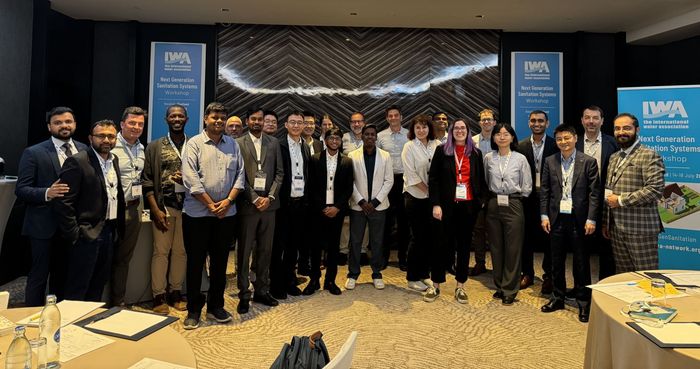
The International Water Association (IWA) successfully concluded the innovation workshop phase of its Next Generation Sanitation Systems (NGSS) initiative in Bangkok in July, bringing together eight exceptional teams, selected from over 100 applications from 40 countries across the globe, to rethink household-scale sanitation systems, with a focus on wastewater treatment.
Held over five days, the workshop served as a platform for interdisciplinary collaboration, technological refinement, and global dialogue. The participating teams represented leading universities, startups, engineering firms, and public research institutes. Their shared objective was to advance next-generation sanitation systems that are affordable, non-biological, scalable, and aligned with international standards.
Opening the workshop, Kala Vairavamoorthy, IWA Executive Director, welcomed participants with a call to action: “We need systems that are modular, decentralised, resilient, and ready to be deployed at scale – not in 20 years’ time – but now, in the next two or three years.”
Over the course of the workshop, participants engaged in technical exchange, iterative design, and team-to-team collaboration. Ideas evolved rapidly — with electrochemical, thermal, and membrane-based processes being reconfigured, combined, and assessed for feasibility under real-world conditions. By the third day of the workshop, teams disassembled and rebuilt their systems by debating trade-offs and identified synergies.
Each team worked closely with an expert panel comprising leaders from industry, academia, engineering testing and the innovation space. Rather than selecting winners, the panel focused on challenging assumptions, guiding cost modelling and energy budgeting, and supporting regulatory compliance pathways. This expert facilitation ensured that final concepts reflected both technical rigour and contextual relevance.
By the final day, teams presented integrated solutions capable of treating all waste streams and meeting stringent regulatory standards. These systems are now positioned to receive support for further refinement, with the goal of future demonstration and deployment, while maintaining a strong focus on cost reduction
Participating teams were from China Agricultural University, Harbin Institute of Technology, Jingdezhen Ceramic University (China), Hydrohm B.V. (Belgium), Indra Water and partners (India), Khanyisa Project and collaborators from South Africa, Austria, Sweden, Switzerland, and Canada, MANN+HUMMEL Water & Fluid Solutions with Duke University and PWW (Germany, USA, Malta), Noah Water Solutions (Belgium), and Stanford University (USA).
The expert panel included Dr Sonia Grego (Coprata and Duke WaSH-AID), Dr Bill Barber (CAMBI), Prof Peng Wang (Sun Yat-Sen University), Mr Ashwin Dhanasekar (Brown & Caldwell), and Dr Farhad Kamranvand (Jacobs).
The workshop was organised and facilitated by the IWA Secretariat team, led by Dr Tao Li, with support from Dr Elena Fernandez-Miranda, Dr Charles Joseph, Jeyannathann Karunanithi, and Veishahan Murugathas.
Looking ahead, we hope to see some of the systems featured at the IWA Water and Development Congress & Exhibition 2025 in Bangkok in December, showcased as examples of how cross-sector innovation can drive progress toward safe, inclusive, and future-ready sanitation for all.
For media inquiries or project information, contact:
Dr Elena Fernandez-Miranda
Project Manager, IWA
elena@iwahq.org