IWA Water and Development Congress & Exhibition 2025 in full flow in Bangkok
Published on Dec 10, 2025
Setting the agenda and celebrating leadership
The International Water Association’s 2025 Water and Development Congress & Exhibition is in full flow in Bangkok, Thailand, with water sector professionals and influential partners and stakeholders engaging in an intensive week-long programme focused on advancing water, sanitation, and resilience in low- and middle-income countries.
Co-organised by the Asian Institute of Technology, the week got under way with a packed opening ceremony on Monday that featured presentation of the 2025 IWA Water and Development Awards to three exceptional individuals.
Professor Evan Thomas of the University of Boulder Colorado, USA received the Water and Development Award – Research, while the Water and Development Award – Practice was presented to Professor Meera Mehta of CEPT University, India and to Jay Bhagwan of South Africa’s Water Research Commission. These recognitions highlight outstanding contributions to scientific advancement and practical implementation that are helping drive progress across the global water sector.
Another highlight of the opening was the launch of the latest edition of the influential Asian Water Development Outlook report of the Asian Development Bank, Principal Strategic Partner of the Congress. Fatima Yasmin, ADB’s Vice President for Sectors and Themes, and Norio Saito, the bank’s Senior Director of Water and Urban Development, launched the report and shared key points. These include that, while more than 60% of Asia and the Pacific’s population – about 2.7 billion people – has been lifted from extreme water insecurity over the past 12 years, an estimated $4 trillion investment is needed in water, sanitation and hygiene by 2040.
A platform for influential voices
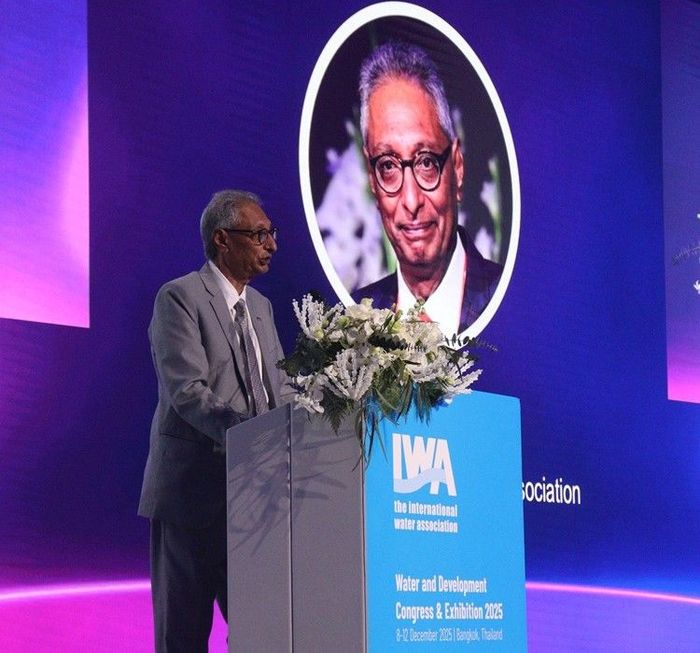
Opening ceremony keynote speaker Jay Bhagwan set the tone for the Congress as a platform for influential voices on water, sanitation and innovation. He shared insights into the real-world opportunities to advance alternative sanitation options – water-efficient sanitation systems featuring both water and resource reuse.
Tuesday, the first full day of event, began with a bold keynote to a packed hall from The Right Honourable Premier of Sarawak, who set out the forward-looking vision for the Malaysian state’s water, energy, and sustainability agenda.
The second plenary session of the day featured a keynote by Yvonne Magawa, Executive Director of ESAWAS Regulators Association, highlighting the pivotal role of regulators in ensuring balanced, accountable and effective water and sanitation services.
The panel discussions alongside the keynotes brought together key stakeholders in the water and sanitation agenda. The first panel unpacked the Asian Development Bank’s Asian Water Development Outlook 2025 report, while the regulatory panel featured perspective from across the regulatory landscape: a utility perspective, from Esper Ncube of Rand Water; a global financing perspective from Gustavo Saltiel, former World Bank lead for water supply and sanitation; and NGO perspectives from Rob Cunningham, responsible for the European watershed programme of TNC, and Tahmidul Islam, technical operations head at WaterAid Bangladesh.
Shaping the direction of policy
An important feature of the first day’s programme was the High-Level Summit on Water Security and Resilience, which brought together leaders from governments, international organisations, and development partners to drive collective action.
Within the context of an expansive Congress programme around the needs of low- and middle-income countries, the Summit focused on the urgent pressures facing communities globally including floods, droughts, pollution, and the growing demand for safe water and sanitation. A key outcome of the Summit is the Bangkok Communiqué, serving as a call to action to accelerate progress in water security and resilience.
Advancing the agenda in low- and middle-income countries
The busy programme is continuing today and got under way with a rousing keynote by Roshan Shrestha of the Gates Foundation, who reflected on the journey of city-wide inclusive sanitation and the take-up of non-sewered sanitation over the past two decades, highlighting its position now as a mainstream option for transforming access to sanitation.
This keynote view was backed up by a vibrant panel discussion with panellists Linda Strande, of EAWAG. Switzerland, Ligy Philip, of Indian Institute of Technology, India, Mandy Mui, of AKYAS Sanitation, Jordan / Hong Kong, and Jennifer Molwantwa, CEO of Water Research Commission, South Africa, with discussion moderated by Professor Evan Thomas.
There are more key programme features yet to come to advance the Congress theme of ‘Water, sanitation, and innovation – pathways to progress and a resilient future’. Find out more at: www.waterdevelopmentcongress.org/programme/key-features/