Young Water Professionals in Action: The Specialist Group on Diffuse Pollution and Eutrophication
Published on Apr 27, 2026
By Andrea Carranza Muñoz & Marina Batalini de Macedo, IWA YWP Steering Committee
Continuing our blog series on IWA's Specialist Groups (SGs), we spoke with Dr Rakesh Kumar, Young Water Professional (YWP) Chair and active member of the IWA Specialist Group (SG) on Diffuse Pollution and Eutrophication. Speaking with him, we quickly moved from the group's mission to something broader: what it actually looks like to be a committed YWP in an SG, and why more people should try it.
The group's focus lies at the intersection of science, policy, and practice. As Dr Kumar explained, the group works to understand, monitor, and address diffuse pollution and eutrophication in both rural and urban water ecosystems, with particular attention to agriculture and nonpoint-source pollution. These are urgent and far-reaching issues. Diffuse pollution threatens rivers, lakes, and groundwater worldwide, including drinking water sources. Eutrophication, driven by excess nutrients like nitrogen and phosphorus, fuels algal overgrowth, depletes oxygen, and disrupts entire aquatic ecosystems. Add emerging contaminants like microplastics and PFAS, and the urgency becomes even clearer. Climate change adds another layer of complexity; the group actively explores if innovative practices can keep pace with shifting environmental conditions and what to do when they cannot.
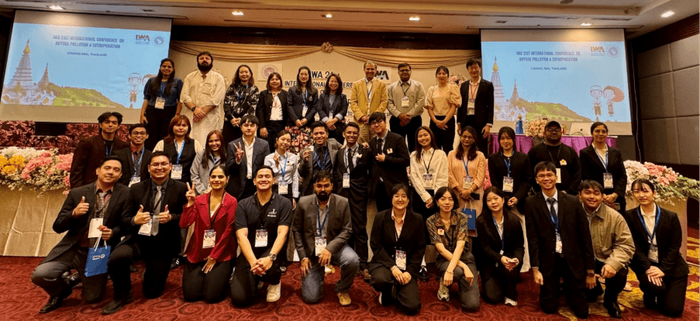
What struck us in our conversation with Dr Kumar was how deliberately the group builds space for engagement at every stage of their professional journey. The SG’s annual conference, DIPCON, brings together researchers, engineers, basin managers, and policymakers from around the world and always includes dedicated early-career sessions and networking spaces where YWPs can interact directly with experienced professionals. The next edition of the conference will be in Vienna, Austria, from 24-26 November 2026. More information is available here.
Beyond the conference, the group publishes a newsletter and holds monthly meetings that include both the leadership and YWPs. YWP members can also contribute in meaningful ways, from co-authoring book chapters to helping draft YWP’s bylaws and shaping the group's future priorities. These are substantive roles that reflect the group’s active and collaborative culture. These are not token assignments; they are real contributions to a group that Dr Kumar describes as one of IWA's most active.
For YWPs considering whether to engage with SGs, Dr Kumar's advice was clear: begin by showing up. Our YWPs, after age 35, have opportunities to contribute and transition into board membership as a regular member, which is exactly how the pipeline is supposed to work. The result is that the group is actively seeking new YWPs to join and be part of our SG. There is real work to be done, mentorship available, and a clear pathway from early involvement to leadership. Volunteer to moderate a session, contribute to a SG’s newsletter, or IWA’s Global Trend Report, or bring an idea to a meeting.
Connect with mentors, not just your immediate supervisor, but established researchers from different countries and disciplines who can broaden your perspective and open doors to collaboration and mentorship. The IWA Specialist Group on Diffuse Pollution and Eutrophication brings together scientists, engineers, policymakers, and community scientists to address shared problems, making it truly multidisciplinary. Dr Kumar personally believes that exposure has been one of the most formative aspects of his involvement as a YWP, developing not only research connections but also leadership capacity, communication skills, and the confidence that comes from completing work independently.
His closing message was also perhaps the most urgent: the group needs to build the next generation of leaders now. That means bringing in YWPs early, giving them opportunities, and creating professional environments, so they can eventually lead the specialist group themselves. If you work on water quality, non-point source pollution, nutrients, or related themes – and if you are ready to contribute, not just observe – this group is actively looking for you.
Interview conducted by Andrea Carranza Muñoz (IWA Young Water Professionals). Our thanks to Dr Rakesh Kumar, YWP Chair of the IWA Specialist Group on Diffuse Pollution and Eutrophication, for sharing his insights and enthusiasm. Dr Kumar is currently a postdoctoral fellow at the Department of Biosystems Engineering, Auburn University, Auburn, United States. Feel free to write Dr Kumar at rakesh.hydrology@gmail.com or rakesh@auburn.edu to get to know more about YWP opportunities in Diffuse Pollution and Eutrophication SG.